Power Calculator (DC, AC, 3-Phase)
Compute real, apparent, and reactive power for DC and AC circuits including single-phase and three-phase systems with adjustable power factor.
Interactive tool
Mode
S = V × I, P = S × cos(φ).
Inputs
Engineering notation accepted (e.g. 1.5k).
Result
What is the Power Calculator?
The Power Calculator computes real, apparent, and reactive power for DC and AC electrical loads. It supports single-phase and balanced three-phase AC systems with an adjustable power factor, so you can size circuits, calculate utility bills, and verify motor or transformer ratings.
How to Use the Calculator
- 1Pick the mode: DC, AC single-phase (1φ), or AC three-phase (3φ)
- 2Enter the voltage and current (RMS for AC, line values for 3φ)
- 3For AC modes, enter the power factor (cos φ): typical values, 0.85 for industrial loads, 0.9 to 1.0 for resistive heaters, 0.6 to 0.8 for older induction motors
- 4Read off real (W), apparent (VA), and reactive (VAR) power plus the phase angle
- 5Copy the result with one click
Key features
Three modes
DC, AC single-phase, and balanced AC three-phase
Real, apparent, reactive
Shows all three components plus power factor and phase angle so you can size both capacity and correction equipment
Engineering notation
Inputs accept SI prefixes (k, M); outputs auto-format to kW, kVA, kVAR for readability
Balanced 3-phase formula
S = √3 × V_L × I_L for line-to-line voltage and line current
Live evaluation
No submit button: results update as you type
100% private
All computation in your browser; no values are uploaded
Why a Power Calculator?
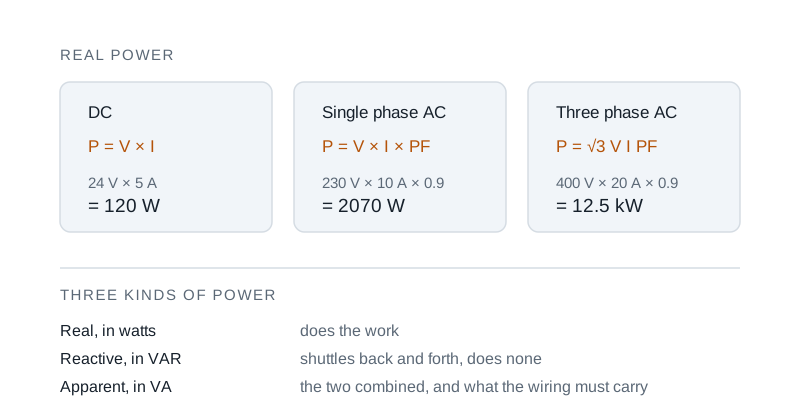
In AC systems, the load draws current that may be partly out of phase with the voltage. That phase shift produces reactive power that the utility delivers but the load does not convert to useful work. Real (W) is what does work, apparent (VA) sizes wires and breakers, and reactive (VAR) sizes capacitor banks. Conflating them is a common source of undersized equipment and over-billed customers.
Common use cases
- Size a circuit breaker or cable from a motor’s nameplate kVA and power factor
- Compute the savings from adding power-factor-correction capacitors
- Convert nameplate kW into kVA for transformer sizing
- Estimate the energy cost of a heater (resistive, PF ≈ 1)
- Verify a three-phase load against the formula P = √3 × V_L × I_L × cos φ
- Teach the relationship between real, apparent, and reactive power
Single-phase vs three-phase formulas
- DC: P = V × I
- AC single-phase: S = V × I, P = S × cos(φ), Q = S × sin(φ)
- AC three-phase (line values, balanced): S = √3 × V_L × I_L, P = S × cos(φ)
- Power triangle: S² = P² + Q²
When power factor matters
Resistive loads (heaters, incandescent bulbs) have PF ≈ 1. Inductive loads (motors, transformers, fluorescent ballasts) lag with PF often 0.7 to 0.9. Modern switching power supplies typically have active PFC and reach 0.95+. Utility companies often charge industrial customers a penalty for PF below ~0.9.
Tips & best practices
RMS, not peak
Always use RMS voltage and current for AC. A 230 V mains supply is 230 V RMS (≈ 325 V peak).
Line vs phase for 3φ
The 3φ mode uses LINE values (V_L, I_L). For a star-connected load, V_L = √3 × V_phase. For delta, line and phase voltages are equal.
Power factor sign convention
A positive PF below 1 means lagging (inductive). Capacitive loads lead the voltage; the magnitude calculation here is symmetric so the result is the same.
Privacy & security
Everything runs in your browser; no values leave your device.
Related tools
- Ohm’s Law Calculator
Solve Ohm’s law for voltage, current, resistance, or power. Enter any two of V, I, R, and P and instantly get the other two with step-by-step derivations.
Electronics & Embedded
- Power Factor Correction Calculator
Compute kVAR and capacitance per phase needed to raise an installation from its current power factor to a target. Before/after power-triangle diagram and current-reduction estimate.
Electronics & Embedded
- PWM Duty & Frequency Calculator
Solve any unknown of a PWM waveform: frequency, period, duty cycle, on-time, off-time. Optional supply voltage gives average and RMS voltage. Inline waveform preview.
Electronics & Embedded
- Short Circuit Current Estimator
Educational point-to-point estimator for available short-circuit current from a transformer secondary, with optional cable attenuation. Not a replacement for IEEE 1584 or utility-provided fault values.
Electronics & Embedded
- Cable Tray Fill Calculator
NEC 392.22 cable tray fill check for ladder, ventilated, and solid-bottom trays. Sums cable areas / diameters and reports pass/fail with the right rule citation.
Electronics & Embedded
- RC Time Constant Calculator
Compute the time constant τ = R × C, plot the charge or discharge curve, and find the time to reach a target voltage for any RC circuit.
Electronics & Embedded
Frequently Asked Questions
What is the difference between watts, VA, and VAR?
Watts (W) are real power: actual energy converted by the load per second. Volt-amperes (VA) are apparent power: the product of RMS voltage and current, used to size wiring and breakers. VAR (volt-amperes reactive) is the reactive power oscillating between the source and reactive components. They are related by S² = P² + Q².
What power factor should I use?
Resistive heaters and incandescent bulbs: PF ≈ 1. Induction motors at rated load: 0.85 to 0.95 (much lower at light load). Fluorescent ballasts: 0.5 to 0.9. Modern switching power supplies with active PFC: 0.95+. Older non-PFC supplies can be 0.6 to 0.7. Use the nameplate value when available.
When do I use the three-phase mode?
Use 3φ mode for balanced three-phase loads where you know the line-to-line voltage and line current. The formula S = √3 × V_L × I_L assumes balance. For unbalanced loads, sum each phase separately.
Do I enter peak or RMS values for AC?
Always RMS. Standard mains voltage (e.g. 230 V or 120 V) is already RMS. If you have a peak measurement (e.g. from an oscilloscope), divide by √2 first.
Can I use this for DC?
Yes: pick the DC mode. With DC, real and apparent power are equal and reactive power is zero (no phase shift).
Is anything sent to a server?
No. The calculation is entirely client-side. Values, results, and any copy events stay on your device.