Cable Tray Fill Calculator
NEC 392.22 cable tray fill check for ladder, ventilated, and solid-bottom trays. Sums cable areas / diameters and reports pass/fail with the right rule citation.
Interactive tool
Tray
Cables
Result
What is the Cable Tray Fill Calculator?
NEC 392.22 governs how full a cable tray can be without overheating the cables inside or making them impossible to install. The rule changes with the tray type (ladder, ventilated, solid bottom) and with the conductor size (smaller vs larger than 4/0 AWG). This tool implements the four most common sub-rules and reports a pass/fail with the cited code section.
How to Use the Calculator
- 1Pick the tray type: ladder, ventilated, or solid bottom
- 2Enter the inside (usable) width and depth in inches
- 3Tick "4/0 or larger" if every conductor is single-conductor 4/0 AWG or above (changes the rule)
- 4Add each cable population: OD in inches and count
- 5Read off the utilisation, allowable limit, and pass/fail badge with the NEC sub-section
Key features
Three tray types
Ladder, ventilated, and solid-bottom support: each maps to the appropriate 392.22 rule
Small vs large wire
NEC switches between sum-of-areas and sum-of-diameters based on conductor size; the tool picks the right rule
Dynamic cable list
Add as many cable populations as you need; each with its own OD and count
Pass / fail badge
Green check or red X depending on whether you’re under the NEC limit
Cited NEC sub-section
392.22(A)(1), (A)(2), (B)(1), or (B)(2) is shown explicitly for the chosen rule
Live evaluation
Updates as you type: no submit button
Why a Cable Tray Fill Calculator?
Cable tray fill is one of the most-misapplied parts of the NEC because the limits depend on the tray type and the conductor size in different ways. Conduit fill is one rule (Chapter 9, Table 1). Tray fill is four rules, and you must pick the right one before you can answer the question. This tool removes that uncertainty.
Common use cases
- Verify a proposed cable run fits in an existing tray
- Specify tray width for a new pull from a load schedule
- Pick between ladder and solid-bottom for cost vs fill efficiency
- Plan-check a contractor’s shop drawings
- Teach the 392.22 sub-section structure to apprentices
NEC 392.22 sub-section summary
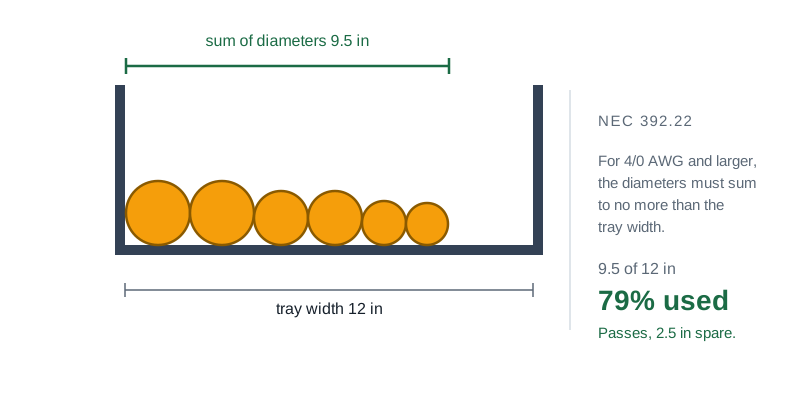
- 392.22(A)(1) Ladder / ventilated, 4/0 AWG and larger: Σ OD ≤ tray inside width
- 392.22(A)(2) Ladder / ventilated, smaller than 4/0 AWG: Σ area ≤ tabular allowable column
- 392.22(B)(1) Solid bottom, 4/0 AWG and larger: Σ OD ≤ 90% of tray width
- 392.22(B)(2) Solid bottom, smaller than 4/0 AWG: 50% of the ventilated allowable area
What is NOT modelled
Mixed power + signal in the same tray, separate signal-only trays, divided trays with barriers, multi-deck stacks, fire-resistive trays, and ampacity adjustments per 392.80 are out of scope. Use the printed code book for those cases.
Cable tray fill chart: cables of 4/0 AWG and larger
For 4/0 AWG and larger, NEC 392.22(A)(1) caps the sum of the cable diameters at the usable tray width. The counts below assume every cable is the same diameter and laid in a single layer.
| Tray width | 1.0 in OD | 1.5 in OD | 2.0 in OD | 2.5 in OD |
|---|---|---|---|---|
| 6 in | 6 | 4 | 3 | 2 |
| 9 in | 9 | 6 | 4 | 3 |
| 12 in | 12 | 8 | 6 | 4 |
| 18 in | 18 | 12 | 9 | 7 |
| 24 in | 24 | 16 | 12 | 9 |
| 30 in | 30 | 20 | 15 | 12 |
| 36 in | 36 | 24 | 18 | 14 |
Mixed diameters need the calculator, which sums the real values rather than dividing by one. Cables smaller than 4/0 follow a different rule based on area rather than diameter, and multiconductor and single conductor cables are treated separately.
Tips & best practices
Choose ladder for big cables
Ladder trays support more cable diameter per inch of tray width and ventilate better. Solid-bottom is restricted to ~half the fill of ladder for small wire.
Mind the future
Fill to 80% of the NEC limit in design so future additions don’t force a tray rebuild.
Sum of diameters is geometry, sum of areas is heating
The two rule families exist because for big cables the limiting factor is physical fit; for small cables the limit is the heat the bundle can shed. Both matter.
Privacy & security
Everything runs in your browser; no values leave your device.
Related tools
- Wire Size Calculator
NEC wire size calculator. Sizes copper or aluminum against Table 310.16 ampacity with ambient and conduit-fill derating, then against your voltage drop target, and reports which limit decided it.
Electronics & Embedded
- 555 Timer Calculator
Design an NE555 astable oscillator or monostable one-shot. Pick R1, R2, C and read off frequency, period, duty cycle, and pulse width, with an inline schematic.
Electronics & Embedded
- UPS Runtime Calculator
Estimate UPS / battery-backup runtime from battery voltage, capacity, series / parallel arrangement, load wattage, inverter efficiency, and depth of discharge. Includes a Peukert warning at high discharge rates.
Electronics & Embedded
- Power Factor Correction Calculator
Compute kVAR and capacitance per phase needed to raise an installation from its current power factor to a target. Before/after power-triangle diagram and current-reduction estimate.
Electronics & Embedded
- Transformer Sizing Calculator
Compute required transformer kVA from connected load, power factor, future growth, K-factor (harmonics), and ambient derating. Picks the next NEMA standard rating.
Electronics & Embedded
- Generator Sizing Calculator
Size a standby or prime generator from continuous load, largest motor (HP + NEMA code letter + start method), altitude and ambient derating. Picks the next standard kW rating.
Electronics & Embedded
Frequently Asked Questions
What does NEC 392.22 actually say?
It limits how much cable can fit in a tray, depending on tray type and conductor size. Ladder / ventilated trays use sum-of-diameter for cables 4/0 and larger, and sum-of-area for smaller cables. Solid-bottom trays are more restrictive in both cases. The tool implements the four most common sub-rules.
How do I measure cable OD?
Use the cable’s datasheet: OD is listed for every common cable type. Measuring with calipers is fine for a single sample but can be inaccurate for armoured or interlocked-armour cable. Don’t use the conductor diameter; the rule is on the outside of the jacket.
Why is the limit different for 4/0 and above?
Big cables stack neatly. For them the limit is geometry: the sum of outside diameters can’t exceed the tray width. Smaller cables stack messily and the limit becomes thermal: the sum of cross-sectional areas can’t exceed a tabulated value derived from the tray’s heat-dissipation capacity.
Does the tool model multi-conductor cable as one cable?
Yes: a 4-conductor 250 kcmil multiconductor cable has a single OD on its datasheet. Treat it as count = 1, diameter = jacket OD. Only single-conductor pulls invoke the 4/0-or-larger rule.
What about ampacity derating?
NEC 392.80 handles ampacity adjustment for cables in trays: a different rule from fill. Both must be satisfied independently. Fill is geometry; ampacity is thermal.
Is anything sent to a server?
No: everything runs in your browser. No values, results, or interactions are uploaded.
How do I size a cable tray?
Add up the outside diameters of every cable if they are 4/0 AWG or larger, and pick a tray at least that wide. For smaller cables the rule works on total cross sectional area against an allowance that depends on the tray type. Then check load depth and support spacing separately.
What is the cable tray fill formula?
For 4/0 AWG and larger in a ladder or ventilated tray, the sum of the cable diameters must not exceed the usable tray width, per NEC 392.22(A)(1). For cables smaller than 4/0 the calculation switches to summing cross sectional areas against a tabulated allowance for the tray width.