Ohm’s Law Calculator
Solve Ohm’s law for voltage, current, resistance, or power. Enter any two of V, I, R, and P and instantly get the other two with step-by-step derivations.
Interactive tool
Pick the two known quantities
Voltage and current known
Inputs
Accepts engineering notation: 10k, 4.7m, 2.2u.
Result
LiveWhat is the Ohm’s Law Calculator?
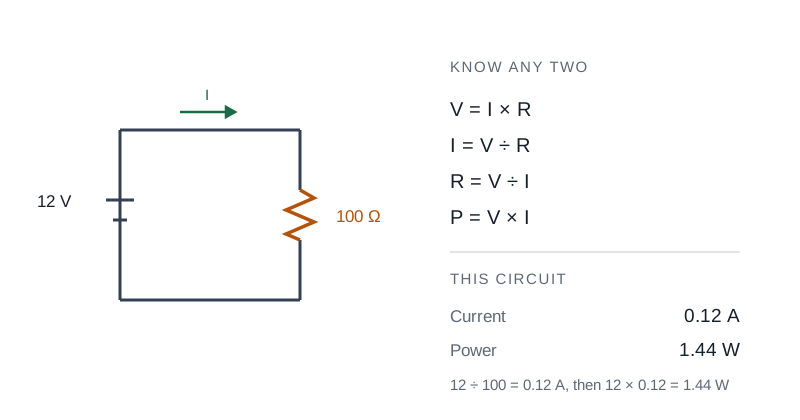
Ohm’s law relates voltage (V), current (I), resistance (R), and power (P) in a DC circuit through V = I × R and P = V × I. This calculator lets you enter any two of these four quantities and instantly compute the other two, with step-by-step derivations so you can verify the math.
How to Use the Calculator
- 1Pick the two quantities you already know (e.g. V and R)
- 2Type the values: engineering notation like 10k, 4.7m, 2.2u is accepted
- 3Read off the derived quantities and the formulas used to compute them
- 4Copy the four-line summary to your clipboard with one click
Key features
All six pairings
Any two of V, I, R, P resolve to the remaining two using the relevant Ohm’s law or power equation
Engineering notation
Inputs accept SI prefixes (k, M, m, µ, n) and outputs use them automatically (e.g. 4.7 kΩ instead of 4700)
Step-by-step derivations
Each result shows the exact formula used, perfect for homework, lab reports, and double-checking calculations
Live evaluation
Results update as you type: no submit button required
Keyboard shortcuts
Cmd/Ctrl+Enter to copy the summary, Cmd/Ctrl+K to clear inputs
100% private
All math runs in your browser; nothing is uploaded
Why a Dedicated Ohm’s Law Calculator?
Ohm’s law is taught in five minutes but applied for a lifetime. Whether you are sizing a current-limiting resistor for an LED, picking a fuse rating for a power rail, or sanity-checking that a 5 V regulator can deliver enough current for your circuit, you reach for this relationship constantly. A focused calculator with engineering notation and derivations is faster and less error-prone than a generic scientific calculator.
Common use cases
- Size a current-limiting resistor for an LED on a 5 V or 12 V rail
- Compute the power dissipated by a pull-up resistor in a digital circuit
- Verify that a regulator or PSU can deliver the current your load needs
- Plan the power budget of an embedded design from per-rail measurements
- Sanity-check meter readings against expected values from a schematic
- Teach beginners how voltage, current, resistance, and power are related
The four core equations
- V = I × R: voltage equals current times resistance
- P = V × I: power equals voltage times current
- P = I² × R: dissipation in a resistor from current and resistance
- P = V² ÷ R: dissipation in a resistor from voltage and resistance
DC only
Ohm’s law as stated here applies to pure DC circuits or the magnitudes in AC circuits with purely resistive loads. For reactive circuits (capacitive, inductive, or mixed) use the Power Calculator with a power factor or work with impedance directly.
Tips & best practices
Watch units
V in volts, I in amperes, R in ohms, P in watts. A 220 mA current is 0.22 A: the engineering-notation input handles that for you.
Pick the most accurate pair
If you measured V and I but estimated R from a color code, prefer the V/I pair so R is derived rather than relied upon.
Resistor power rating
A resistor must be rated for at least the dissipation you compute here, ideally with a 2× safety margin. See also the LED Resistor Calculator for a built-in recommendation.
Privacy & security
Everything runs in your browser. No values, derivations, or copy events leave your device.
Related tools
- Power Calculator (DC, AC, 3-Phase)
Compute real, apparent, and reactive power for DC and AC circuits including single-phase and three-phase systems with adjustable power factor.
Electronics & Embedded
- Voltage Drop Calculator
NEC voltage drop calculator. Enter system, voltage, current, one-way length and conductor, and get volts dropped, percent drop, voltage at the load and the smallest conductor that meets your target.
Electronics & Embedded
- Conduit Fill Calculator
NEC Chapter 9 conduit-fill calculator. Pick conduit type and trade size, add cables (THHN/THWN/XHHW by AWG), and get utilisation, NEC limit, and pass/fail.
Electronics & Embedded
- Resistor Color Code Decoder
Decode and encode 3, 4, 5, and 6-band resistor color codes. Pick colors to read the value, or enter a value to see the matching color bands.
Electronics & Embedded
- LED Resistor Calculator
Size the current-limiting resistor for a single LED, an LED chain in series, or several LEDs in parallel. Picks the nearest standard E-series value and recommends a safe wattage rating.
Electronics & Embedded
- Motor Full Load Current Calculator
Compute motor full-load current (FLA / FLC) for DC, single-phase, and three-phase motors from horsepower or kilowatts, efficiency, and power factor. Side-by-side NEC 430.250 reference.
Electronics & Embedded
Frequently Asked Questions
What is Ohm’s law?
Ohm’s law states that the current through a conductor between two points is directly proportional to the voltage across them and inversely proportional to the resistance, i.e. V = I × R. Combined with P = V × I, any two of V, I, R, and P determine the other two.
Why do I need to enter exactly two values?
Ohm’s law and the power equation give you two independent relationships among four unknowns, so any two known values determine the system. Entering one value leaves it underdetermined; entering three risks an inconsistent system.
Does this work for AC circuits?
For DC and purely resistive AC loads, yes. For AC circuits with reactive components (capacitors, inductors, motors) you also need the power factor or the impedance: use the Power Calculator with the appropriate mode.
How do I enter values like 4.7 kΩ or 220 µA?
Type "4.7k", "220u", or "4.7e3": the input accepts standard SI prefixes (k, M, m, µ/u, n) as well as scientific notation. The result tiles also use engineering notation, so you read off "4.7 kΩ" rather than "4700".
How accurate is the result?
The math runs in standard 64-bit floating point, which is essentially exact for any practical electrical engineering calculation (relative precision below 1 part in 10¹⁵).
Is my data sent to a server?
No. Every calculation runs in your browser. No values, results, or copy events are uploaded, logged, or stored anywhere outside your device.