LED Resistor Calculator
Size the current-limiting resistor for a single LED, an LED chain in series, or several LEDs in parallel. Picks the nearest standard E-series value and recommends a safe wattage rating.
Interactive tool
Topology
A single LED with one dropping resistor.
Inputs
Result
What is the LED Resistor Calculator?
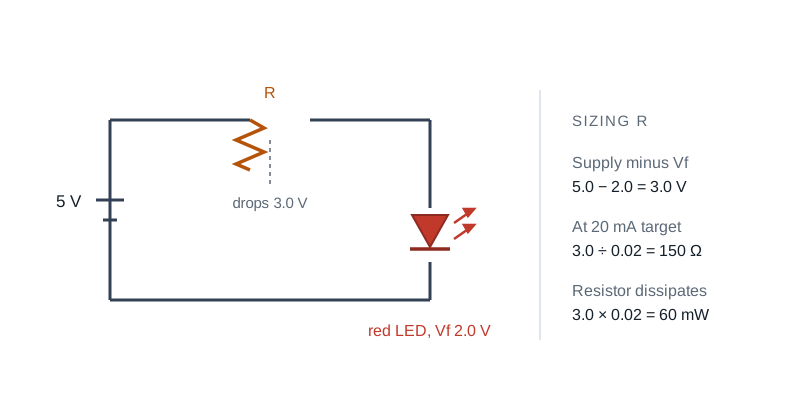
LEDs are current-driven, not voltage-driven: connect one directly across a supply higher than its forward voltage and it will draw too much current and burn out within seconds. This tool sizes the series resistor that limits LED current to a safe value for single LEDs, series strings, and parallel banks.
How to Use the Calculator
- 1Pick a topology: Single, Series (N in a row sharing one resistor), or Parallel (N branches, one resistor each)
- 2Enter the supply voltage: use the chip presets for common rails (5 V, 12 V, etc.)
- 3Pick the LED forward voltage from the color presets, or enter Vf from the datasheet
- 4Enter the LED current: typical small LEDs run at 10 to 20 mA, high-brightness can be 30 mA+
- 5Read the calculated resistance, the recommended physical wattage rating, and the nearest E12/E24/E96 standard values
Key features
Three topologies
Single LED, series chain (one resistor for N LEDs), or parallel branches (one resistor each)
LED color presets
Red (1.8 V), Yellow (2.0 V), Green (2.1 V), Blue (3.3 V), White (3.3 V), IR (1.2 V), UV (3.4 V)
Current presets
Quick-pick buttons for 5, 10, 15, 20, and 30 mA
E-series suggestions
Nearest value from E12 (10%), E24 (5%), and E96 (1%) with deviation percentage
Wattage recommendation
Recommends the smallest common physical wattage rating with a 2× safety margin
Feasibility check
Warns if the supply voltage is not high enough to drive the requested LED count in series
Why a Dedicated LED Calculator?
The fastest way to ruin an LED is to forget the resistor or use one that’s too small. Even when you remember the formula R = (Vsupply − Vled) / Iled, you still need to pick a real standard value, check power dissipation, decide between series and parallel, and verify the supply can drive the chain. This tool collapses all of that into a single screen, with sensible defaults you can adjust.
Common use cases
- Drive a panel indicator LED from a 5 V or 12 V rail
- Wire a row of LEDs in series under a single resistor for a status bar
- Replace a burned-out LED in a kit: verify the supplied resistor matches
- Plan a low-power LED strip running off a battery pack
- Drive an IR LED for a remote-control transmitter or emitter array
- Teach beginners why "one resistor per LED" is safer in parallel than a single shared resistor
The math
- R = (Vsupply − N × Vled) / Iled
- P_R = Iled² × R
- For parallel: one resistor per branch, total supply current = N × Iled
- For series with N LEDs: Vsupply must exceed N × Vled (otherwise the chain will not light)
Series vs parallel: which to use
Series is more efficient (only one resistor for the whole chain) but limited by supply voltage: at 5 V you can drive one blue LED and a dropping resistor, not two. Parallel works at any supply but needs a resistor per branch and tolerates LED variation: a single shared resistor on N parallel LEDs causes current hogging and is strongly discouraged.
Tips & best practices
Always round UP the wattage
A 0.06 W calculation calls for at least a 1/8 W (0.125 W) resistor. Most through-hole resistors are 1/4 W, which is the safe default for tiny logic-LED jobs.
Pick the next-larger standard value
When the exact value isn’t standard, pick the next LARGER E12/E24/E96 value. It lowers the current slightly, which is harmless. A smaller value would push the LED past its rated current.
Check the LED datasheet
Forward voltage varies with current and temperature. Use the value at your actual operating current. The presets are typical small-signal LED values; high-power LEDs (Cree, Luxeon, etc.) have different curves.
Privacy & security
All math runs in your browser; no values leave your device.
Related tools
- Power Factor Correction Calculator
Compute kVAR and capacitance per phase needed to raise an installation from its current power factor to a target. Before/after power-triangle diagram and current-reduction estimate.
Electronics & Embedded
- Transformer Sizing Calculator
Compute required transformer kVA from connected load, power factor, future growth, K-factor (harmonics), and ambient derating. Picks the next NEMA standard rating.
Electronics & Embedded
- Generator Sizing Calculator
Size a standby or prime generator from continuous load, largest motor (HP + NEMA code letter + start method), altitude and ambient derating. Picks the next standard kW rating.
Electronics & Embedded
- Voltage Divider Calculator
Calculate the output voltage, current, and power of a resistive voltage divider with optional load. Highlights loading effects when the load is too small.
Electronics & Embedded
- Power Calculator (DC, AC, 3-Phase)
Compute real, apparent, and reactive power for DC and AC circuits including single-phase and three-phase systems with adjustable power factor.
Electronics & Embedded
- PWM Duty & Frequency Calculator
Solve any unknown of a PWM waveform: frequency, period, duty cycle, on-time, off-time. Optional supply voltage gives average and RMS voltage. Inline waveform preview.
Electronics & Embedded
Frequently Asked Questions
Why does an LED need a series resistor?
LEDs have a near-vertical I-V curve above their forward voltage: a tiny change in voltage causes a huge change in current. The series resistor converts the supply’s voltage drop into a controlled current, protecting the LED from thermal runaway.
What forward voltage should I use?
Use the typical Vf at your operating current from the datasheet. Common rule-of-thumb values: red 1.8 V, yellow 2.0 V, green 2.1 V, blue 3.3 V, white 3.3 V, IR 1.2 V, UV 3.4 V. High-brightness and high-power LEDs may have very different curves.
Series or parallel for multiple LEDs?
Series wires N LEDs end-to-end with a single resistor: efficient, but requires Vsupply > N × Vf. Parallel runs each LED on its own branch, each with its own resistor: works at any supply and tolerates per-LED variation. A single shared resistor across parallel LEDs causes current hogging and is not recommended.
What resistor wattage should I buy?
The tool recommends the smallest common rating that exceeds 2× the calculated dissipation. For small logic LEDs at 20 mA on 5 V or 12 V, that’s nearly always 1/4 W (0.25 W): a safe default.
My LED looks dim: should I use a smaller resistor?
Maybe, but only down to the LED’s rated current. Dropping below the recommended resistor pushes the LED past its current spec and shortens its life dramatically. If you need more brightness, choose a brighter LED (mcd or mW spec) rather than over-driving a dim one.
Is anything sent to a server?
No. All calculations happen in your browser; nothing is uploaded or logged.