Conduit Fill Calculator
NEC Chapter 9 conduit-fill calculator. Pick conduit type and trade size, add cables (THHN/THWN/XHHW by AWG), and get utilisation, NEC limit, and pass/fail.
Interactive tool
Conduit
Cables
Result
What is the Conduit Fill Calculator?
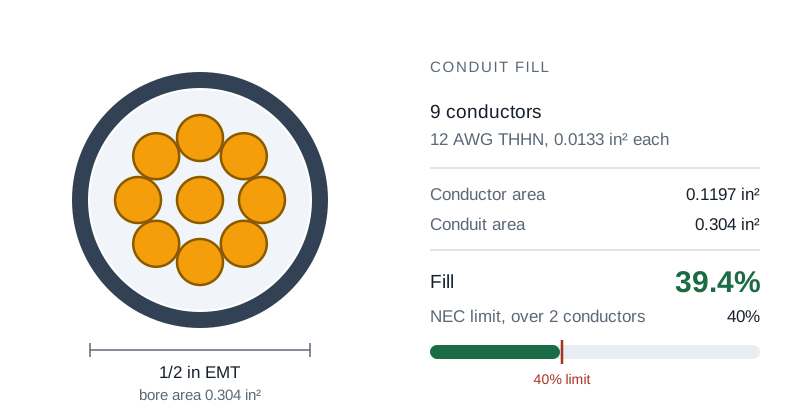
NEC Chapter 9 conduit fill is a simple ratio: sum of conductor cross-sectional areas divided by conduit internal area. The result must stay below the table-1 limit: 53% for one conductor, 31% for two, 40% for over two. This tool sums the areas correctly for mixed insulations and AWG sizes, then compares against the right limit.
How to Use the Calculator
- 1Pick the conduit type (EMT, IMC, RGS, PVC40, PVC80, ENT, FMC)
- 2Pick the trade size (1/2" through 6", as available for the type)
- 3Add each cable population: insulation type, AWG (14 to 1000 kcmil), and count
- 4Read off the fill percent, NEC limit, pass/fail, and per-cable area breakdown
Key features
NEC Chapter 9 Table 4
Internal areas for all common conduit types and trade sizes
NEC Chapter 9 Table 5
Conductor areas for THHN / THWN / THWN-2 / XHHW from 14 AWG to 1000 kcmil
Correct fill limit
Picks 53% / 31% / 40% based on total conductor count automatically
Mixed cable populations
Add as many rows as you need; each can have its own insulation, AWG, and count
Per-cable breakdown
Shows the area each row contributes for sanity-checking
Pass / fail badge
Green check or red X depending on whether you’re under the NEC limit
Why a Conduit Fill Calculator?
Pulling too many conductors through too small a conduit is one of the most common code violations on site. It’s also a real install problem: over-filled conduit damages insulation during the pull, traps heat, and makes future re-pulls impossible. The right time to check fill is during design, not at inspection. The calculator gives you a NEC-cited answer in seconds.
Common use cases
- Specify conduit size for a sub-panel feed
- Verify a proposed cable population fits in existing conduit before re-pull
- Convert a cable schedule into a one-line conduit size
- Spot-check a contractor’s shop drawings
- Teach students NEC Chapter 9 with real numbers
NEC Chapter 9, Table 1 (allowable fill)
- 1 conductor: 53%
- 2 conductors: 31%
- Over 2 conductors: 40%
- These are the limits the calculator compares against, based on the total conductor count you enter.
The formula behind the chart
- Fill percentage is the total cross sectional area of the conductors divided by the internal area of the conduit.
- Conductor areas come from Chapter 9 Table 5 and depend on the insulation as well as the gauge, so THHN and XHHW of the same AWG are not interchangeable in a tight pull.
- Conduit internal areas come from Chapter 9 Table 4 and differ between EMT, IMC, RGS, PVC40, PVC80, ENT and FMC at the same trade size.
- The permitted percentage comes from Chapter 9 Table 1 and depends only on how many conductors there are: 53% for one, 31% for two, 40% for more than two.
What is NOT modelled
Bundling / proximity derating (NEC 310.15(C)(1)), nipple fill, and special raceways (cable tray, wireways, busways) are out of scope. This is the Chapter 9 conduit-fill rule only. For trays see the Cable Tray Fill calculator.
Conduit fill chart: EMT with THHN conductors
Maximum number of same size THHN conductors in EMT at the NEC 40% limit that applies to more than two conductors. These counts come from the same Chapter 9 Table 4 and Table 5 areas the calculator uses, so the chart and the tool cannot disagree.
| EMT trade size | 14 AWG | 12 AWG | 10 AWG | 8 AWG | 6 AWG |
|---|---|---|---|---|---|
| 1/2 in | 12 | 9 | 5 | 3 | 2 |
| 3/4 in | 21 | 16 | 10 | 5 | 4 |
| 1 in | 35 | 25 | 16 | 9 | 6 |
| 1-1/4 in | 61 | 44 | 28 | 16 | 11 |
| 1-1/2 in | 83 | 61 | 38 | 22 | 16 |
| 2 in | 138 | 100 | 63 | 36 | 26 |
For one conductor the limit is 53% and for exactly two it is 31%, so those cases allow fewer than a third of the counts above would suggest. Mixed AWG sizes and other conduit types need the calculator, which sums the real areas rather than reading a single column.
Tips & best practices
Mind the pull length
Filling to 40% is the code limit, not best practice. For long pulls or many bends, drop to ~30% to keep pulling tension reasonable and protect insulation.
Insulation matters
XHHW is slightly larger than THHN at the same AWG, especially at small sizes. Switching insulation types in a tight pull can flip a borderline pass into a fail.
Pull box vs conduit
Conduit fill is separate from pull-box / junction-box sizing (NEC 314.28). A passing conduit fill does not guarantee a passing pull box.
Privacy & security
Everything runs in your browser; no values leave your device.
Related tools
- Voltage Drop Calculator
NEC voltage drop calculator. Enter system, voltage, current, one-way length and conductor, and get volts dropped, percent drop, voltage at the load and the smallest conductor that meets your target.
Electronics & Embedded
- Resistor Color Code Decoder
Decode and encode 3, 4, 5, and 6-band resistor color codes. Pick colors to read the value, or enter a value to see the matching color bands.
Electronics & Embedded
- LED Resistor Calculator
Size the current-limiting resistor for a single LED, an LED chain in series, or several LEDs in parallel. Picks the nearest standard E-series value and recommends a safe wattage rating.
Electronics & Embedded
- Signal Attenuation (dB) Calculator
Convert between power / voltage ratios and dB, compute Free-Space Path Loss (FSPL), and estimate cable attenuation. Supports forward and reverse calculations.
Electronics & Embedded
- ADC / DAC Converter Calculator
Convert between analog voltage and digital code for any N-bit ADC or DAC. Computes LSB size, quantisation error, full-scale range, and ideal dynamic range (SQNR).
Electronics & Embedded
- Capacitor Charge & Energy Calculator
Compute the stored charge (Q = CV) and energy (E = ½ CV²) of a charged capacitor, with intuitive real-world comparisons.
Electronics & Embedded
Frequently Asked Questions
What is the NEC conduit fill limit?
NEC Chapter 9, Table 1: 53% for one conductor, 31% for two conductors, 40% for over two conductors. The calculator picks the right limit automatically based on your total conductor count.
Where do the conductor areas come from?
NEC Chapter 9, Table 5, which lists approximate cross-sectional areas for THHN, THWN, THWN-2, XHHW and a few other insulations from 14 AWG to 1000 kcmil. The tool uses these tabulated areas: don’t calculate them from the bare-conductor diameter.
Why are EMT and PVC 80 different sizes for the same trade size?
Trade size refers to the nominal designation, not the actual internal diameter. PVC80 has thicker walls than PVC40, so the internal area is smaller. EMT internal area is similar to PVC40. RGS has the largest internal area for its trade size.
Does this tool account for ambient temperature derating?
No: ambient and bundling derating (NEC 310.15) is a conductor-ampacity question, not a conduit-fill question. Fill checks the geometry; derating limits the current. Both must be satisfied independently.
What about EGC (ground) conductors?
Every conductor counts toward fill, including the EGC. Bare EGCs use the same Table 5 area as their AWG (the insulation column doesn’t matter for the bare case).
Is anything sent to a server?
No: everything runs in your browser. No values, results, or interactions are uploaded.
How many wires can I put in 1/2 inch conduit?
At the 40% limit that applies to more than two conductors, half inch EMT takes 12 of 14 AWG THHN, 9 of 12 AWG, 5 of 10 AWG, 3 of 8 AWG or 2 of 6 AWG. The chart above covers trade sizes up to 2 inch, and the calculator handles mixed gauges, which a single column cannot.
Is the conduit fill chart different for PVC?
Yes. PVC40 and PVC80 have thicker walls than EMT at the same trade size, so the internal area is smaller and fewer conductors fit. PVC80 is the tightest of the common types. The percentage limits are identical; only the area the percentage applies to changes.