Motor Full Load Current Calculator
Compute motor full-load current (FLA / FLC) for DC, single-phase, and three-phase motors from horsepower or kilowatts, efficiency, and power factor. Side-by-side NEC 430.250 reference.
Interactive tool
Presets
Inputs
Result
What is the Motor Full Load Current Calculator?
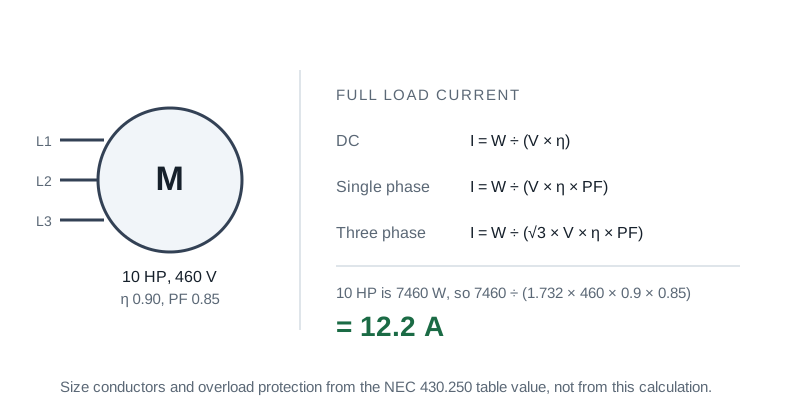
This tool computes the full-load current (FLC, also called FLA: full-load amperes) drawn by a motor from its shaft horsepower / kilowatts, line voltage, efficiency, and power factor. It supports DC, single-phase AC, and three-phase AC motors, and cross-references your result against NEC Article 430.250 tabulated values.
How to Use the Calculator
- 1Pick the motor type: DC, 1-phase, or 3-phase
- 2Enter the rated mechanical power in HP or kW (toggle the unit selector)
- 3Enter line voltage (L-N for 1-phase, L-L for 3-phase)
- 4Enter efficiency as a decimal (0.85 to 0.95 typical for induction motors)
- 5Enter power factor (ignored for DC)
- 6Read off the FLC, input power, apparent power, and the NEC 430.250 reference
Key features
DC / 1-phase / 3-phase
Tagged-union mode toggle picks the right formula automatically (I = P / (V·η), with PF added for AC, and √3 for 3-phase)
NEC 430.250 cross-reference
For 3-phase motors at 208/230/460/575 V, side-by-side comparison with the tabulated NEC values
HP ↔ kW
Unit toggle, no manual conversion
Apparent power
Shows VA drawn from the line in addition to the FLC
Engineering disclaimer
Calculated values are for sizing conversations: conductor and overcurrent sizing must use NEC 430.250 nameplate values
Live evaluation
Updates as you type: no submit button
Why a Motor FLC Calculator?
Motor full-load current sets the conductor ampacity, the overcurrent device, and the contactor rating. Reading it off a nameplate is best, but a quick calculated estimate is invaluable for scoping a panel before you buy the motor. Crucially, the NEC requires conductor sizing to be based on the tabulated 430.250 values, not the nameplate. This tool puts the two numbers side-by-side so you can see the difference.
Common use cases
- Size conductors and overcurrent devices before motor selection
- Sanity-check a motor nameplate against the calculated FLA
- Compare DOL vs VFD-fed current draw for the same load
- Estimate apparent power on a 1-ph residential motor for a sub-panel
- Convert between HP and kW for catalog cross-shopping
Formulas
- DC: I = P_out / (V · η)
- 1-phase: I = P_out / (V · η · cosφ)
- 3-phase: I = P_out / (√3 · V_LL · η · cosφ)
- 1 HP = 745.7 W
NEC 430.250 vs nameplate
NEC 430.250 gives a conservative table of FLA used for conductor and OCPD sizing. The nameplate FLA on the motor is what the motor actually draws at rated load. Always size conductors to NEC 430.250 (or your local code equivalent) and overload protection to the nameplate.
Tips & best practices
Default efficiencies are rough
Premium-efficiency 3-phase induction motors (NEMA Premium) hit 0.92 to 0.95 at full load; older or smaller motors are closer to 0.85 to 0.88. Use the nameplate when you have it.
Service factor is not modelled
Motors with SF > 1.0 (typical 1.15) may draw above the FLA during temporary overload. Conductor sizing accounts for this through the NEC 125% rule.
Starting current is much higher
This tool returns full-load current. Inrush / locked-rotor amps (LRA) can be 5 to 8× FLA. See the Generator Sizing tool for motor-starting capacity sizing.
Privacy & security
Everything runs in your browser; no values leave your device.
Related tools
- Short Circuit Current Estimator
Educational point-to-point estimator for available short-circuit current from a transformer secondary, with optional cable attenuation. Not a replacement for IEEE 1584 or utility-provided fault values.
Electronics & Embedded
- Cable Tray Fill Calculator
NEC 392.22 cable tray fill check for ladder, ventilated, and solid-bottom trays. Sums cable areas / diameters and reports pass/fail with the right rule citation.
Electronics & Embedded
- RC Time Constant Calculator
Compute the time constant τ = R × C, plot the charge or discharge curve, and find the time to reach a target voltage for any RC circuit.
Electronics & Embedded
- Signal Attenuation (dB) Calculator
Convert between power / voltage ratios and dB, compute Free-Space Path Loss (FSPL), and estimate cable attenuation. Supports forward and reverse calculations.
Electronics & Embedded
- ADC / DAC Converter Calculator
Convert between analog voltage and digital code for any N-bit ADC or DAC. Computes LSB size, quantisation error, full-scale range, and ideal dynamic range (SQNR).
Electronics & Embedded
- Capacitor Charge & Energy Calculator
Compute the stored charge (Q = CV) and energy (E = ½ CV²) of a charged capacitor, with intuitive real-world comparisons.
Electronics & Embedded
Frequently Asked Questions
What is motor FLC (full load current)?
FLC: also called FLA, full-load amperes, is the line current a motor draws at rated mechanical load. It is the design point for conductor ampacity and the overcurrent protective device. For starting current see locked-rotor amps (LRA), which can be 5 to 8× FLC.
What is the formula for 3-phase motor current?
I = P_out / (√3 · V_LL · η · cosφ), where P_out is shaft power in watts, V_LL is line-to-line voltage, η is efficiency, and cosφ is power factor. Typical values are η ≈ 0.90 and PF ≈ 0.85 for a NEMA Premium induction motor at rated load.
Should I size conductors to the calculated FLA or NEC 430.250?
In the US, conductor and OCPD sizing uses the tabulated NEC 430.250 values, not the nameplate or a calculated FLA. Motor overload protection uses the nameplate FLA. This tool puts both numbers side-by-side for awareness.
How do I convert HP to kW?
Mechanical horsepower: 1 HP = 745.7 W = 0.7457 kW. The tool has a unit toggle so you don’t have to do this manually.
Why does the NEC reference differ from my calculated value?
NEC 430.250 values are intentionally conservative. They assume worst-case efficiency / PF so the resulting conductor ampacity always covers a typical motor. Your calculation with realistic nameplate η and PF will usually be lower.
Is anything sent to a server?
No: everything runs in your browser. No values, results, or interactions are uploaded.