Capacitor Charge & Energy Calculator
Compute the stored charge (Q = CV) and energy (E = ½ CV²) of a charged capacitor, with intuitive real-world comparisons.
Interactive tool
Presets
Inputs
Engineering notation: 1000u = 1000 µF, 2.2n = 2.2 nF.
Result
What is the Capacitor Charge & Energy Calculator?
A charged capacitor stores energy in its electric field. Two numbers describe this: the charge Q = C × V (in coulombs) and the energy E = ½ C V² (in joules). This tool computes both for any capacitance and voltage, and translates the joule value into intuitive comparisons, because "0.5 J" rarely tells you whether the cap can light an LED for a second or for an hour.
How to Use the Calculator
- 1Enter the capacitance C in farads (use engineering notation: 100n, 10u, 1000u, 1)
- 2Enter the terminal voltage V in volts
- 3Read off the stored charge Q, the stored energy E, and the intuitive comparisons
- 4Use the presets to see typical ceramic, electrolytic, and supercapacitor values at a glance
Key features
Charge and energy
Q in coulombs (and equivalent Ah/mAh), E in joules (and equivalent Wh/mWh)
Intuitive comparisons
"Enough to power a 1/4 W LED for X seconds": puts joules in real-world terms
Engineering notation
Inputs accept SI prefixes; outputs auto-scale (µC, mC, J, mJ, Wh)
Useful presets
Ceramic decoupling caps, electrolytics, PSU bulk caps, and supercaps
Live evaluation
No submit button; results update as you type
100% private
All math runs in your browser; no data is uploaded
Why a Capacitor Energy Calculator?
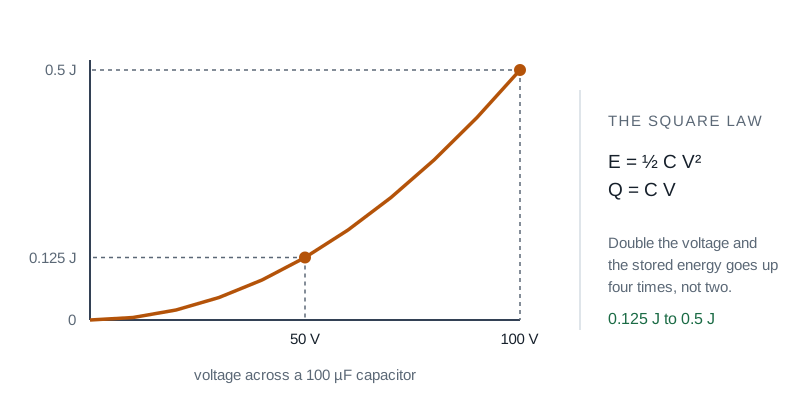
Capacitor energy density is easy to under- or over-estimate. A 100 µF / 50 V electrolytic stores 0.125 J: enough to draw a respectable spark but not enough to hold up a microcontroller through a power blip. A 100 F supercapacitor at 2.7 V holds 364 J: enough to back up RAM for minutes. Translating the formula E = ½ CV² into something you can act on is what this tool does.
Common use cases
- Size a bulk power-supply capacitor for the hold-up time you need
- Estimate the spark hazard of a charged capacitor in industrial equipment
- Compare supercaps and small Li-Po cells for energy-harvesting designs
- Calculate the discharge energy when fault current flows through a defibrillator cap
- Teach E = ½ CV² to students with hands-on real values
- Plan a flash capacitor for a camera or strobe
Formulas
- Q = C × V (coulombs)
- E = ½ × C × V² (joules)
- Energy scales with the square of voltage: doubling V quadruples E
- 1 J = 0.278 mWh; 1 Wh = 3600 J
Energy density by type
- Ceramic (X7R, 100 nF / 50 V): ~125 µJ
- Electrolytic (1000 µF / 25 V): ~0.31 J
- Tantalum (10 µF / 16 V): ~1.3 mJ
- Supercapacitor (1 F / 2.7 V): ~3.6 J per farad-volt-squared
- Li-Po cell (1000 mAh / 3.7 V): ~13.3 kJ, about four orders of magnitude denser than a supercap
Tips & best practices
Voltage rating matters
Always charge to less than the rated voltage. Most aluminium electrolytics are happy at 80% of rated; running closer shortens life significantly.
Polarized caps care about polarity
Reverse-biasing an electrolytic releases the stored energy as a small explosion. Mind the polarity stripe.
Stored vs delivered
A real cap can’t deliver all of E at full voltage: voltage falls as it discharges. Useful energy down to a brown-out threshold is less than E.
Privacy & security
All math runs in your browser; no values leave your device.
Related tools
- Voltage Divider Calculator
Calculate the output voltage, current, and power of a resistive voltage divider with optional load. Highlights loading effects when the load is too small.
Electronics & Embedded
- Power Calculator (DC, AC, 3-Phase)
Compute real, apparent, and reactive power for DC and AC circuits including single-phase and three-phase systems with adjustable power factor.
Electronics & Embedded
- PWM Duty & Frequency Calculator
Solve any unknown of a PWM waveform: frequency, period, duty cycle, on-time, off-time. Optional supply voltage gives average and RMS voltage. Inline waveform preview.
Electronics & Embedded
- Short Circuit Current Estimator
Educational point-to-point estimator for available short-circuit current from a transformer secondary, with optional cable attenuation. Not a replacement for IEEE 1584 or utility-provided fault values.
Electronics & Embedded
- Cable Tray Fill Calculator
NEC 392.22 cable tray fill check for ladder, ventilated, and solid-bottom trays. Sums cable areas / diameters and reports pass/fail with the right rule citation.
Electronics & Embedded
- RC Time Constant Calculator
Compute the time constant τ = R × C, plot the charge or discharge curve, and find the time to reach a target voltage for any RC circuit.
Electronics & Embedded
Frequently Asked Questions
What is the formula for capacitor energy?
E = ½ × C × V², where C is capacitance in farads and V is voltage in volts. The result is in joules. Stored charge is Q = C × V in coulombs.
Why does doubling the voltage quadruple the energy?
Because energy scales with V squared. Going from 5 V to 10 V on the same capacitor stores 4× the energy. This is why high-voltage caps (PSU bulk, defibrillators, photoflashes) hold so much: it’s the voltage doing the work, not the capacitance.
How does a supercapacitor compare to a Li-Po battery?
Energy density differs by roughly 1000×1 to 10000×. A 100 F / 2.7 V supercap holds about 365 J. A 1000 mAh / 3.7 V Li-Po holds about 13,300 J. Supercaps win on cycle life and peak power; batteries win by orders of magnitude on energy.
Can I get all the stored energy out?
No. As you draw current, the capacitor voltage drops. The useful energy is the difference between the starting energy and the energy at the brown-out threshold of your load. Going from 5 V to 3 V on a 1 F cap delivers only 8 J of the original 12.5 J.
Is high-energy capacitor discharge dangerous?
Yes: above a few joules, an instantaneous discharge can cause burns, vaporise metal, or trigger arc-flash. Always bleed high-voltage caps through a resistor before handling, and respect the energy rating of your equipment.
Is anything sent to a server?
No. All computation happens in your browser. Nothing is uploaded.