Generator Sizing Calculator
Size a standby or prime generator from continuous load, largest motor (HP + NEMA code letter + start method), altitude and ambient derating. Picks the next standard kW rating.
Interactive tool
Presets
Continuous Load
Largest Motor
Site
Result
What is the Generator Sizing Calculator?
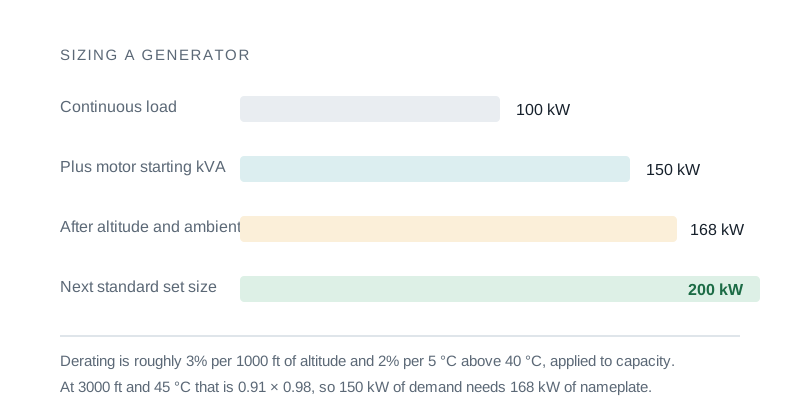
A first-pass generator sizing calculator that combines continuous load with motor-start kVA and applies altitude / ambient derating. The result is a required kW number snapped to the next standard genset rating.
How to Use the Calculator
- 1Enter the continuous load in kW, the aggregate PF, and a future-growth multiplier
- 2For the largest single motor, enter HP, NEMA code letter, and starting method (DOL, soft-start, VFD)
- 3Enter site altitude in feet and ambient temperature in °C
- 4Read off continuous kVA, motor-start kVA, required kVA, derating factor, and the next standard kW rating
Key features
Motor-start kVA
Uses the NEMA 430.7(B) code letter to compute locked-rotor kVA at start
Start method
DOL = 100% LRA, soft-start ≈ 45%, VFD ≈ 15%: dramatically reduces required kVA
Altitude derate
3% per 1000 ft above 1000 ft (capped at 30%)
Ambient derate
2% per 5 °C above 40 °C (capped at 20%)
NEMA standard ratings
[10, 15, 20, 25, 30, 40, 50, 60, 75, 100, 125, 150, ...]
Engineering disclaimer
Reinforces that final sizing needs a vendor study
Why a Generator Sizing Calculator?
Standby and prime generators are sized for two things: continuous load and the worst-case starting transient. A 100 kW continuous load with a 50 HP DOL motor needs a much bigger generator than the same load with a VFD-fed motor, because the DOL start pulls 6 to 7× the motor’s FLA for a few seconds. This tool puts both numbers in front of you so the trade-off is visible.
Common use cases
- Specify a standby generator for an industrial facility
- Compare DOL vs soft-start vs VFD for the same motor
- Estimate the impact of altitude on a remote site genset
- Size a prime generator for a continuous-use installation
- Sanity-check a vendor proposal
Formulas
- Continuous kVA = continuous kW × growth / PF
- Starting kVA = HP × LRA_factor(code) × start_method_factor
- DOL: 1.0 Soft-start: 0.45 VFD: 0.15
- Pre-derate kVA = Continuous kVA + Starting kVA
- Altitude derate = max(0, ((altitudeFt − 1000) / 1000) × 3%) (capped 30%)
- Ambient derate = max(0, ((°C − 40) / 5) × 2%) (capped 20%)
- Derating factor = 1 − (altitudeDerate + ambientDerate)
- Required kVA = Pre-derate kVA / Derating factor
- Required kW = Required kVA × 0.8 (standard genset PF)
NEMA code letters at a glance
Code A: <3.15 kVA/HP, B: 3.15 to 3.55, ..., G: 5.6 to 6.3 (typical NEMA Premium), H: 6.3 to 7.1, ..., V: >22.4. If the motor nameplate doesn’t list the code letter, "G" is the safest default for modern induction motors.
Tips & best practices
VFD changes everything
A VFD-fed motor draws roughly its full-load amps at start, not 6 to 7×. If you can VFD the largest motor, the generator can be ~50% smaller.
Step-load sequence
For multiple motors, stagger the starts. The genset only sees one motor’s inrush at a time, which lets you size to the largest single motor instead of the sum.
Block load vs walking load
Standby applications often face a block load on transfer (the whole panel hits the genset at once). That’s more stressful than walking-load and can require a bigger genset than the steady-state numbers suggest. Vendor sizing tools model this; this calculator does not.
Privacy & security
Everything runs in your browser; no values leave your device.
Related tools
- Conduit Fill Calculator
NEC Chapter 9 conduit-fill calculator. Pick conduit type and trade size, add cables (THHN/THWN/XHHW by AWG), and get utilisation, NEC limit, and pass/fail.
Electronics & Embedded
- Motor Full Load Current Calculator
Compute motor full-load current (FLA / FLC) for DC, single-phase, and three-phase motors from horsepower or kilowatts, efficiency, and power factor. Side-by-side NEC 430.250 reference.
Electronics & Embedded
- Ohm’s Law Calculator
Solve Ohm’s law for voltage, current, resistance, or power. Enter any two of V, I, R, and P and instantly get the other two with step-by-step derivations.
Electronics & Embedded
- Wire Size Calculator
NEC wire size calculator. Sizes copper or aluminum against Table 310.16 ampacity with ambient and conduit-fill derating, then against your voltage drop target, and reports which limit decided it.
Electronics & Embedded
- 555 Timer Calculator
Design an NE555 astable oscillator or monostable one-shot. Pick R1, R2, C and read off frequency, period, duty cycle, and pulse width, with an inline schematic.
Electronics & Embedded
- UPS Runtime Calculator
Estimate UPS / battery-backup runtime from battery voltage, capacity, series / parallel arrangement, load wattage, inverter efficiency, and depth of discharge. Includes a Peukert warning at high discharge rates.
Electronics & Embedded
Frequently Asked Questions
How is generator size calculated?
Required kVA = continuous kVA (kW × growth / PF) + motor-start kVA, then divided by the combined altitude + ambient derating factor. The result is converted to kW at the standard generator PF of 0.8 and snapped to the next NEMA-style standard rating.
What does the NEMA code letter mean?
NEC 430.7(B) classifies motors A through V based on locked-rotor kVA per HP. Code A is below 3.15 kVA/HP (very low inrush). Code G (5.6 to 6.3 kVA/HP) is typical for NEMA Premium induction motors. Bigger code letters mean higher inrush, requiring a bigger generator to start.
How much does VFD starting help?
A lot. DOL pulls roughly 6 to 7× the motor’s full-load amps for a few seconds. A VFD ramps the motor up at near-rated current. The tool models DOL as 100% of locked-rotor kVA, soft-start as 45%, VFD as 15%. For a 100 HP motor, that’s the difference between a 250-kVA bump and a 90-kVA bump.
Why derate for altitude and temperature?
Engines breathe air. Thinner air (altitude) means less oxygen per stroke and less power output. Higher ambient temperature also means less dense air and worse heat rejection. The tool applies 3% per 1000 ft above 1000 ft (cap 30%) and 2% per 5 °C above 40 °C (cap 20%), which matches typical OEM data sheets.
When should I use this vs a vendor sizing tool?
Use this for first-pass capacity conversations and rough budgeting. Use the vendor tool (Caterpillar SpecSize, Cummins GenSize, Kohler PowerSpec, etc.) for the final purchase, because it models the actual alternator, block-load vs walking-load, harmonic content, and step sequences explicitly.
Is anything sent to a server?
No: everything runs in your browser. No values, results, or interactions are uploaded.