Transformer Sizing Calculator
Compute required transformer kVA from connected load, power factor, future growth, K-factor (harmonics), and ambient derating. Picks the next NEMA standard rating.
Interactive tool
Presets
Load
Multipliers
Result
What is the Transformer Sizing Calculator?
Given the real-power load (kW), its aggregate power factor, a future-growth multiplier, a harmonic K-factor multiplier, and an ambient-temperature derating, this tool returns the required kVA and the nearest NEMA / ANSI standard rating to pick.
How to Use the Calculator
- 1Enter the total connected load in kW
- 2Enter the aggregate power factor (0.85 to 0.95 for typical mixed loads)
- 3Set a growth multiplier: 1.25 (= +25%) is the conventional default for new builds
- 4Set the K-factor if the load is harmonic-heavy (K-4 for office mixed loads, K-13 for data center, K-20 for VFD-rich industrial)
- 5Set ambient derating if installed in a hot environment (e.g. 0.95 above 40°C)
- 6Read off the required kVA, the next standard rating, and the resulting headroom
Key features
NEMA standard ratings
Snaps to the next size in [10, 15, 25, 37.5, 50, 75, 112.5, 150, 225, 300, 500, 750, 1000, 1500, 2000, 2500]
Growth multiplier
Common practice is 25% future growth; the tool defaults there and lets you override
K-factor for harmonics
Multiplies the required kVA: essential for VFD- and switch-mode-load-heavy systems
Ambient derating
Hot-environment installations need a derated rating
Headroom %
Shows how much spare capacity the chosen standard rating gives you
Live evaluation
Updates as you type: no submit button
Why a Transformer Sizing Calculator?
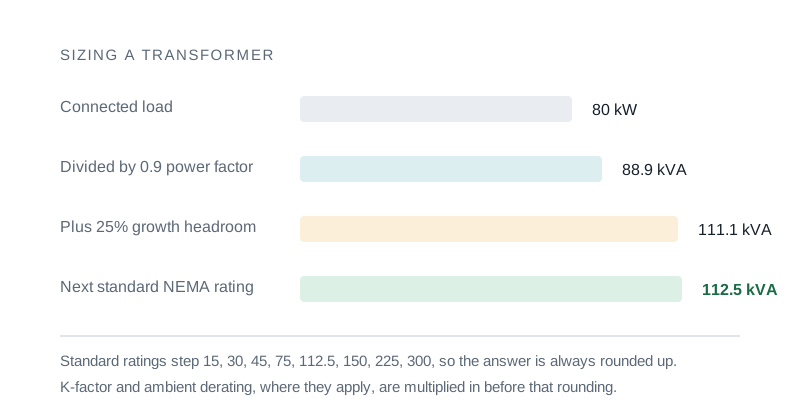
Undersized transformers run hot and shorten insulation life. Oversized transformers waste capital and run inefficiently at light load. The right transformer is the smallest standard rating that covers (load / PF) × growth × K-factor / ambient derate. This tool does that calculation in seconds and shows the headroom you’re paying for.
Common use cases
- Spec a service-entrance transformer for a new commercial building
- Specify a step-down transformer for a 480 → 208 sub-system
- Replace an existing transformer with a K-rated unit for harmonic-heavy load
- Compare two sites for the same load with different ambient conditions
- Estimate capital cost based on standard ratings rather than custom designs
Formulas
- Load (kVA) = kW / PF
- Required kVA = Load kVA × growth × K-factor / ambientDerate
- Standard rating = smallest NEMA size ≥ required kVA
- Headroom (%) = (standard - required) / standard × 100
K-factor cheat sheet
K-1: pure linear loads. K-4: typical office (some non-linear). K-13: heavy electronics, data center. K-20: VFD-rich industrial. K-30/40: solid-state heating, welders. Pick the next size up if in doubt; K-rated transformers cost ~15-25% more than equivalent linear units but tolerate the additional eddy losses.
Tips & best practices
Diversity factor first
Connected load is usually larger than coincident demand. Apply a diversity factor (0.7 to 0.9 for offices, 1.0 for continuous industrial) before plugging into this calculator. Otherwise you’ll oversize.
Liquid vs dry type
Standard ratings are the same; thermal behaviour and footprint differ. For indoor installations dry-type avoids the spill containment requirement. Outdoors, liquid-filled is more efficient and cheaper per kVA.
IEC vs NEMA
NEMA / ANSI ratings: 10, 15, 25, 37.5, 50, 75, 112.5, 150, ... IEC has slightly different breakpoints. The tool ships NEMA values; for IEC procurement, pick the IEC rating immediately above the calculated required kVA.
Privacy & security
Everything runs in your browser; no values leave your device.
Related tools
- Voltage Drop Calculator
NEC voltage drop calculator. Enter system, voltage, current, one-way length and conductor, and get volts dropped, percent drop, voltage at the load and the smallest conductor that meets your target.
Electronics & Embedded
- Conduit Fill Calculator
NEC Chapter 9 conduit-fill calculator. Pick conduit type and trade size, add cables (THHN/THWN/XHHW by AWG), and get utilisation, NEC limit, and pass/fail.
Electronics & Embedded
- Resistor Color Code Decoder
Decode and encode 3, 4, 5, and 6-band resistor color codes. Pick colors to read the value, or enter a value to see the matching color bands.
Electronics & Embedded
- ADC / DAC Converter Calculator
Convert between analog voltage and digital code for any N-bit ADC or DAC. Computes LSB size, quantisation error, full-scale range, and ideal dynamic range (SQNR).
Electronics & Embedded
- Capacitor Charge & Energy Calculator
Compute the stored charge (Q = CV) and energy (E = ½ CV²) of a charged capacitor, with intuitive real-world comparisons.
Electronics & Embedded
- TOTP Generator
Generate Time-based One-Time Passwords (2FA codes) from a secret with QR code for authenticator apps
Encoding Tools
Frequently Asked Questions
How do I size a transformer?
Compute kVA from kW / PF, multiply by future growth (typically 1.25), multiply by K-factor if the load is harmonic-heavy, and divide by an ambient derating if installed in a hot environment. Pick the next standard NEMA / ANSI rating at or above that number.
What is K-factor and why does it matter?
K-factor is a multiplier on the transformer’s eddy losses caused by harmonic currents. Non-linear loads (VFDs, switch-mode supplies, LED drivers) inject harmonics that overheat a standard transformer’s windings. A K-rated transformer is designed to tolerate that. Typical values: K-1 linear, K-4 office mixed, K-13 data center, K-20 VFD-rich industrial.
What growth factor should I use?
Industry default is 1.25 (= +25%) for new construction. Mature, fully built-out sites can use 1.0. Greenfield expansions where load is uncertain often use 1.5. Going below 1.0 means assuming load will shrink: rare and risky.
Does this account for diversity?
No. You should multiply the connected load by a diversity factor first (0.7 to 0.9 for offices, 1.0 for continuous industrial) and feed the result into kW. Otherwise the calculation oversizes.
NEMA vs IEC ratings
The tool ships NEMA / ANSI C57.12.10 ratings (10, 15, 25, 37.5, 50, 75, ...). IEC has slightly different breakpoints (e.g. 100, 160, 250, 315 ...). For IEC procurement, use the next IEC rating above the calculated required kVA.
Is anything sent to a server?
No: everything runs in your browser. No values, results, or interactions are uploaded.